
We had an exciting time in Manchester on a trip this July and learned many lessons about how technology is changing the business of ecommerce and fashion. Originally, we just came to Manchester to attend a seminar about artificial intelligence and what it means for fashion ecommerce at Manchester Fashion Institute, but we ended up doing a few side quests in the city. Recently, the latest batch of MFI students had graduated and shown their final collections at Manchester Fashion Institute’s Graduate Showcase 2026 and we used the opportunity to reach out to them and ask them whether they would be interested in giving us an interview for our blog.
We always aim to be experts in all the industries that we serve so that we don’t just understand how to set up a successful ecommerce store in Shopify, but also how our clients conduct their business and what it takes to be successful in the business of fashion. In the past we went to tradeshows like Tranoï and Paris Fashion Week to meet the current generation of independent brands and designers, but during this U.K. trip, we thought it would be great to get a glimpse into the future and find out about what the next generation of fashion designers plans, before they even enter the industry and start their own independent fashion labels.

This isn't a trend report. It's closer to a school photo with footnotes: a snapshot of where this particular group of MMU graduates is standing right now, in their own words. We've kept the names out of the body of the piece to present the common voice of everyone, but we will give everyone who shared their voice with us a proper thank you rather than a byline at the end of this article. Please note that the placment of the images in this blog artile don't directly line up with the content of the text. We simply added as many imges of the young designers work to showcase their craft.
The final collections
Ask a graduating designer to explain their final collection and you get, almost without exception, a compressed year of obsession delivered in ninety seconds.
One designer built hers around structure rather than silhouette: dramatic, repeated circular forms that let the garment's construction do the talking. "I just hope that people notice that the garments aren't just about final appearances, but also how they're constructed," she told us. She's off to the Royal College of Art for a master's next.

Another went somewhere darker: the Scottish witch hunts, and the misogyny she found still recognisable today. Her signature move was incorporating a 3D-printing practice she'd only started that September into an otherwise traditional craft, "I really like to involve the technology without losing the traditional craft side of it as well." is what she expressed to us.
The most technically ambitious project of the bunch came from a designer working in jackets with graphene screen-printed straight into the fabric. It’s a piece that generates power as you move via kinetic-energy harvesting in the sleeve, another with LEDs stitched into the collar and wired to an automotive-grade hall sensor, so the lights react to how you walk. She believes she's the first person to successfully screen-print graphene ink into a garment. Her research partner was Manchester's own Graphene Institute. She expressed the thought that access like this, she says, she'd never have had in London.
One collection took the opposite approach to technology entirely: a fully reversible, fully modular line made entirely from dead stock and scrap denim, built so nothing about it ever goes out of style. "The idea of a garment that you kind of keep falling in love with," as she put it. "That is forever exciting."

Another spent her final year unpacking her own mixed heritage: Mauritian, Vincentian and English, using sublimation-printed traditional Caribbean madras fabric worked into her own designs. Her takeaway message for anyone who sees the work: "Never shy away from who you are."
One of the more narrative-driven collections built a matriarchal folklore around early farming and Edwardian nightwear. The story behind it, women fleeing captivity in their own commune, wrapped in stolen wool jackets. It was selected as a finalist for the Hyères competition and also heads to a runway in China this October.

Another fused Alfred Wainwright's Lake District guidebooks with technical outdoor wear, using ultrasonic welding instead of stitching the finished garment so that "actually the garment as a whole could be recycled." she told us proudly.
And one collection, called Quiet Survivor, explored identity through cracked, weathered textures, with a message its designer wanted people to walk away with: that struggling doesn't mean you're alone.
Where they're headed next
Almost nobody in this group is launching a label on graduation day, and most of them told us that's by design.
Several are heading straight into master's programs, one to the RCA, another staying in Manchester to chase a patent for her graphene work. One has already landed a job as an assistant designer at a sustainability-focused, modular-clothing brand she describes as almost exactly what she'd want her own label to be one day. Another is freelancing while eyeing bridal fashion as a stepping stone toward her real dream: couture. One is working at a bespoke couture wedding-dress studio, using the pattern-cutting skills from her degree, alongside new skills in social media and event photography she picked up along the way.

The pattern, pun fully intended, when it comes to starting their own business, if there is one, is patience. One of the designers put it bluntly: starting something of her own right now "seems like a nice idea," but the foundations of actually running a business are a different matter entirely and she wants a few years working for a smaller, values-aligned designer first.
What makes each of them tick
Push past the collection pitch and the "what's distinctly yours" question tends to surface the real answer.

For one, it's sampling as a design tool, not just a testing step. It’s about letting construction and material generate the design rather than the other way round. For another, it's an almost mathematical approach to pattern cutting, sketched out in coloured pens before anything gets made. For a third, it's the opposite instinct entirely: hand-manipulated, spur-of-the-moment pulling and rushing of fabric, "I couldn't really predict what the outcome was going to be." One designer laughed about this question, because she starts every project telling herself she won't do patchwork, and ends every project having done patchwork anyway. "It's unintentional. I would say it's a piece of me at this point.", she shared with us.
Manchester, not London
We heard a version of the same story from nearly every person we spoke to: Manchester wasn't the fallback option, it was the better one.
One designer, who grew up on a farm, found London simply too big at eighteen. Another studied a foundation year in London before transferring to Manchester and never looked back, because "Everyone's friendly, it feels really friendly here." in her opinion. It’s an opinion we share about Manchester, everyone has been open and welcoming. A third called it a place that feels "about to boom," with a collaborative creative scene she contrasted with what she'd heard about London's every-man-for-himself culture. One turned down an offer from Westminster to come north, and said the smaller scale of Manchester helped her find an identity of her own rather than getting lost comparing herself to everyone else. The most concrete reason came from the graphene designer: Manchester's Graphene Institute simply doesn't exist anywhere else, and it shaped her entire final year.

Not everything about Manchester got glowing reviews. One flagged that the city's fashion scene still leans heavily casual and could use more room for high-end, one-of-one work, and another noted it's a more commercial, less experimental market than London's.
Building a brand of their own
First and foremost, we wanted to get to know the individuals who will shape the world of fashion in the U.K., whether they want to do it as part of their career in an already established brand or chart their own path towards running their own business and building a brand that is theirs. However, we do love entrepreneurship and understanding how business actually works which is why we also had to ask them about their plans to start their own labels and we loved what they had to share.
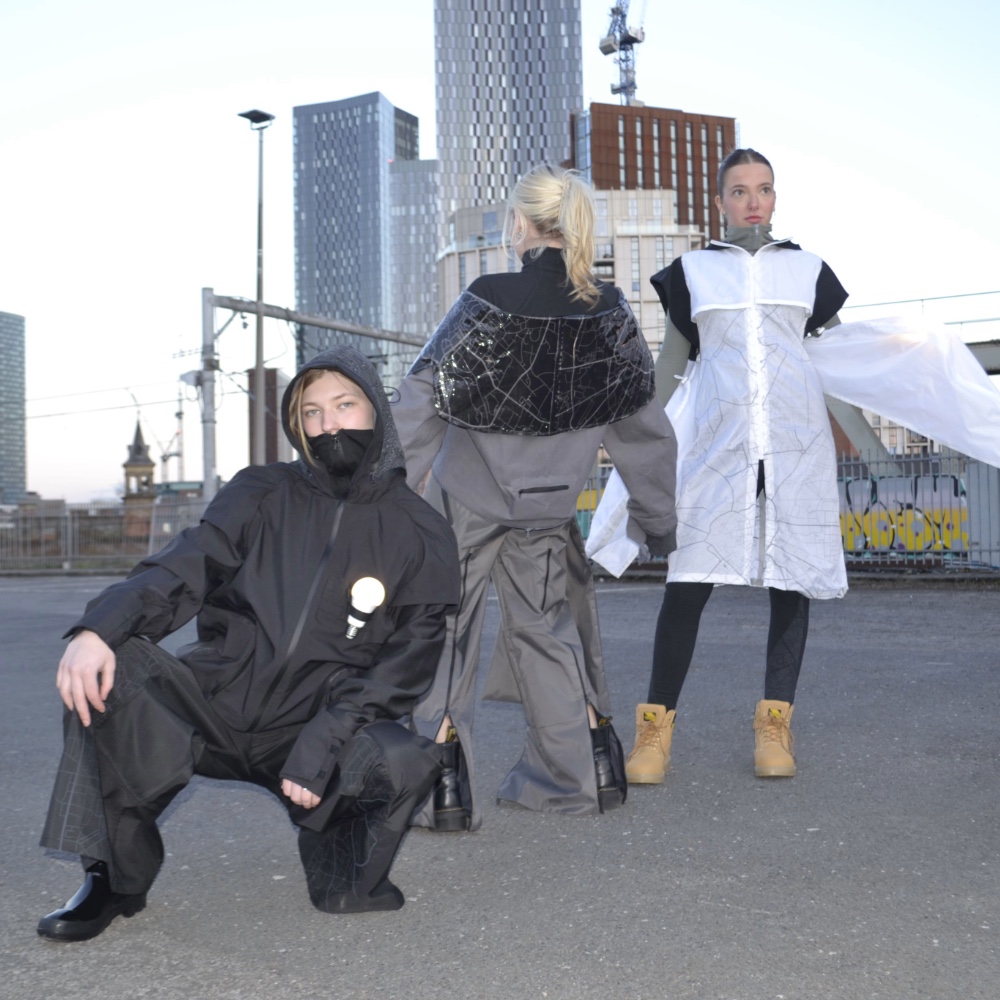
One would build a contemporary womenswear line around construction and longevity, citing Issey Miyake as the brand whose philosophy, not just aesthetic, she admires most. Another wants high-quality, sustainable eveningwear, name-checking Chopova Lowena as a brand that never sacrifices story for craft. One already has the name picked out, a deliberately misspelled play on her own surname, envisioning a heritage-inspired streetwear label built on denim and sublimation-printed textiles. Another wants a unisex, modular, sustainability-first label that would essentially be the brand she's about to go work for, built with her own hands eventually.
One is pivoting toward something almost playful: a festival-wear line of mix-and-match, narrative-driven pieces, inspired by 90s John Galliano and early Alexander McQueen. The graphene designer’s brand would sit somewhere between Stone Island and CP Company, striving to be technical, wearable outerwear with genuine innovation underneath, aiming for something like Vollebak. She's hoping to have "a foot in the ground" within five to seven years. And one is already testing the waters, quietly building a small custom client base and figuring out whether Etsy, Shopify, or her own site comes first, ahead of a streetwear-meets-avant-garde label.

Almost everyone in this group converged on the same three answers when we asked about production, selling, and money: made-to-order or small-batch to start; their own website plus Instagram and TikTok for discovery; and self-funding or family support first, with outside investment only once there's something real to invest in. The most common "biggest unknown" wasn't creative, as it turns out, it is pricing, scaling, and simply not knowing where to start on the business side. One designer summed up the group's approach to asking for help best: "Ask for advice, get money twice."
The quick-fire round
Not everyone had time for the full interview, but they still sent word on what's next. One is torn between working for Vivienne Westwood one day and a growing pull toward print publications over social media. Another is chasing a fully digital product-development process, convinced the industry is lagging behind on it. One wants to bring craftsmanship, playfulness and storytelling into whichever brand she ends up designing for. Another is building a socially and politically driven brand that's already using scannable QR codes woven into print. One is aiming for a knitwear design or programming role, with a bridal-and-eveningwear label somewhere down the line. Another wants broad creative-team experience before building a brand of her own. And one is looking past fashion entirely, toward life as a multidisciplinary artist with a studio of her own one day.
So, what's next for this class?
Mostly, what is next, is a few years of learning somebody else's business before they try building their own. Which, if you've watched any founder's early career up close, is usually the smartest first move anyone can make.
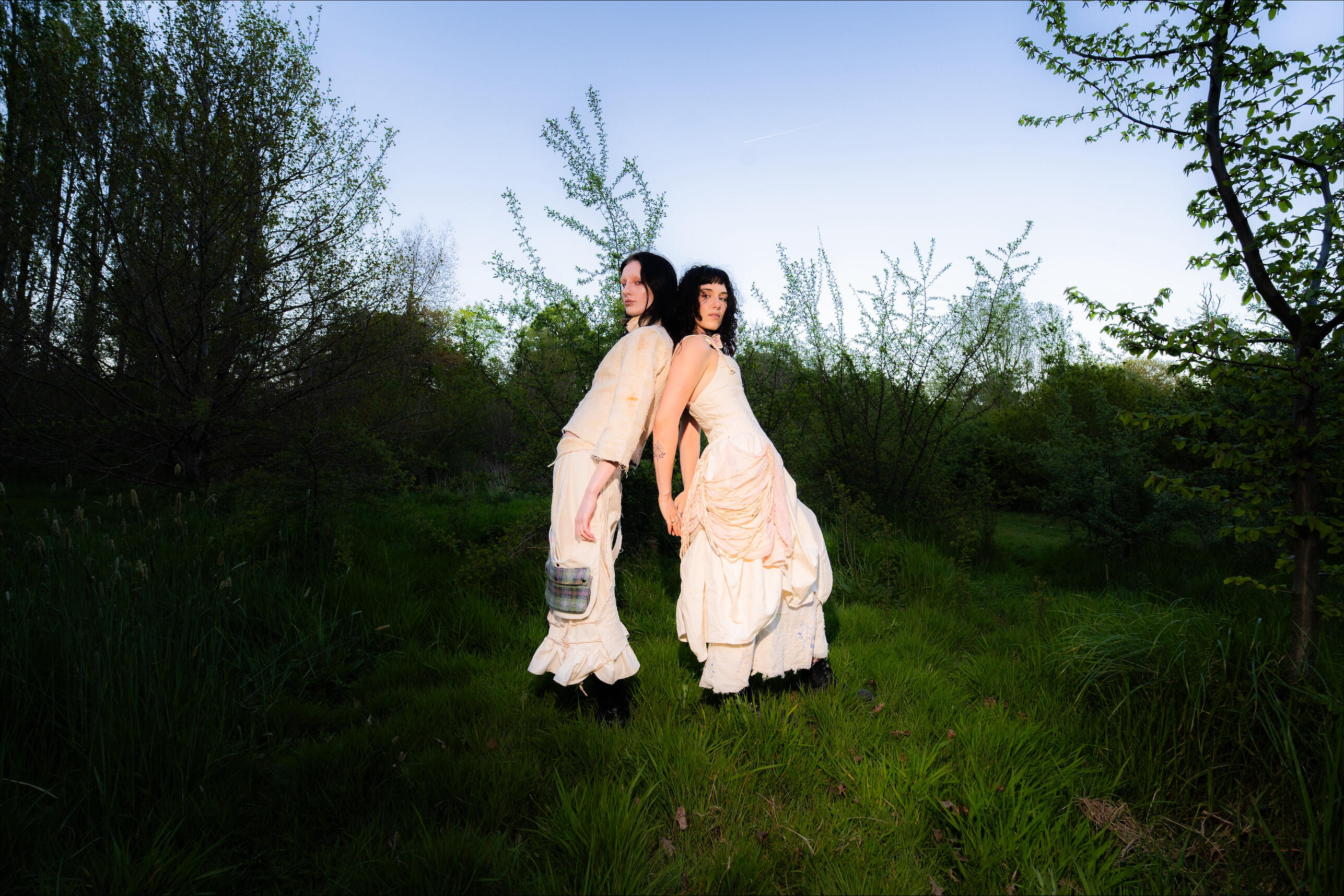
We'll be keeping an eye on this group. If even a handful of them are still making things in five years, we suspect some will be worth writing about twice.
A big thank you
This piece wouldn't exist without the fourteen Manchester Fashion Institute graduates who gave their time, their collections, and in several cases a great deal of patience with a stranger's voice recorder. Good luck to all of you! We mean it.
About The Author
Bastian Lauer is one of the founders of Mata Creative Services. MCS is a company helping brands of all sizes build and maintain their ecommerce websites. We've worked with over 20 ecommerce brands, mostly in fashion, luxury, cosmetics, jewelry, and skincare. We helped our clients build and maintain websites which accumulate 10M visits, over $70M in total sales and half a million orders during a usual year.
Notes, Attribution & Credits:
The Team Behind: Luna Orbiter
Project Contention: Luna Orbiter, Emma Birtles
L5 Project, Looks 2025
Designer: @styledbyglittergirl
Art Direction: @hollypotter._
Photography & Post-Production: @rubyi5dumb
Styling: @gothwizard_
Model: @katie_wbanks
The Team Behind: Taste
Taste, L6 Graduate Collection, Emma Birtles
Manchester Fashion Institute showcase
Designer: @styledbyglittergirl
Photography: @rkellyphoto
Models: @emilyb_nn, @hanrosewalters, @stefifromtheinternet
The Team Behind: Foreverwear
Isabella Goldsmith
BA (Hons) Fashion Design and Technology, Manchester Fashion Institute 2026
Designer: @_actuallyisa
Thank you for sharing your thoughts with us
- Charlotte Mansfield
- Cerys Scott-Hobbs
- Kemi Charters-Bastide
- Erinne Ho
- Isobel Goacher
- Issy Goldsmith
- Madeleine Edwards
- Oliwia Blues
- Rowan Simms Ridgway
- Aaysha Mehran
- Emma Birtles
- Emmanuella Mensah
- Florence Newport
- Isobel Goacher
- Gareth Godfrey-Williams
- Sophie Parry